
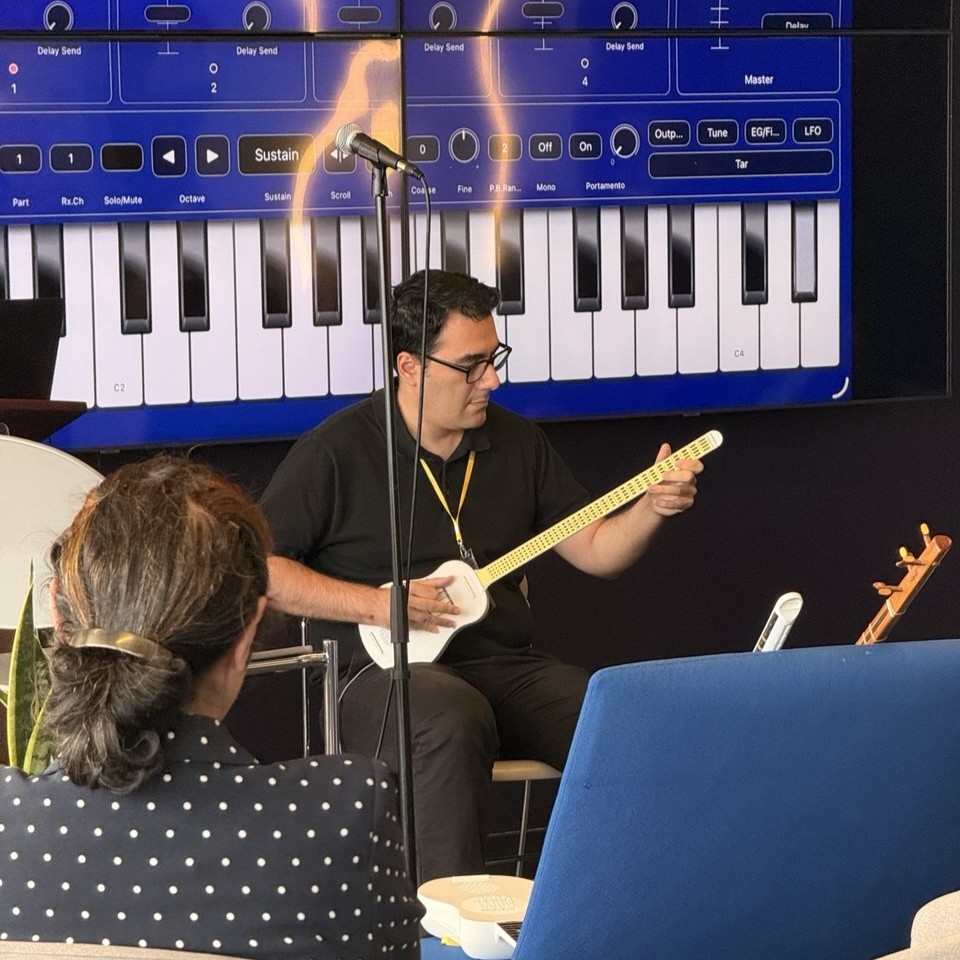
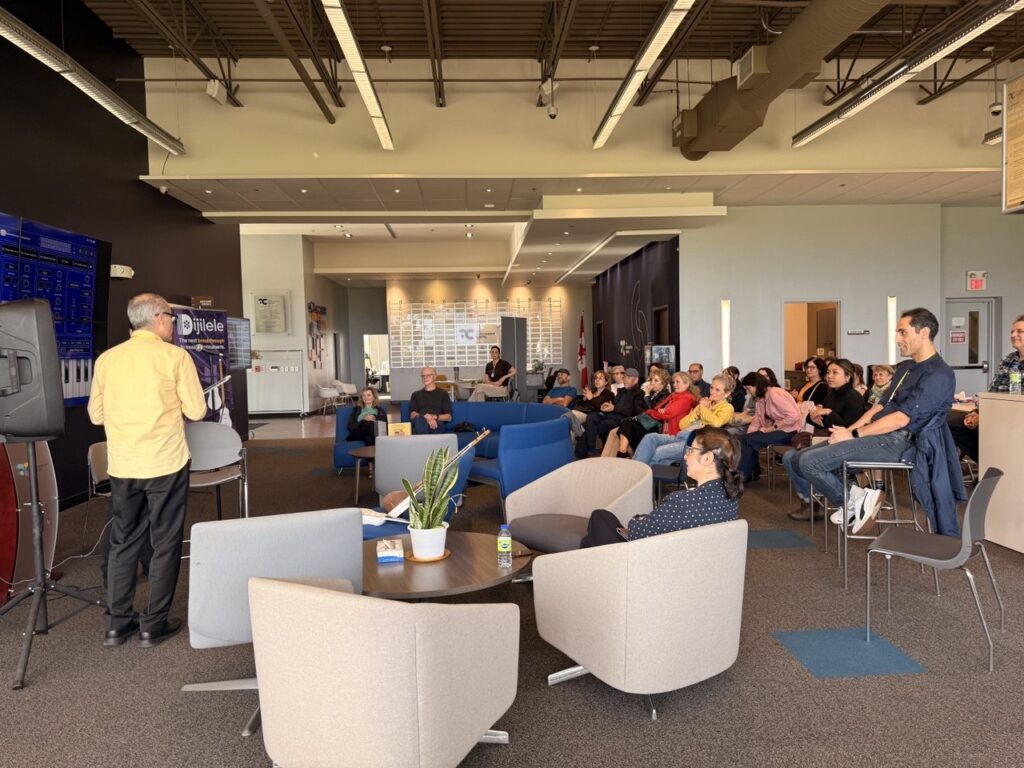
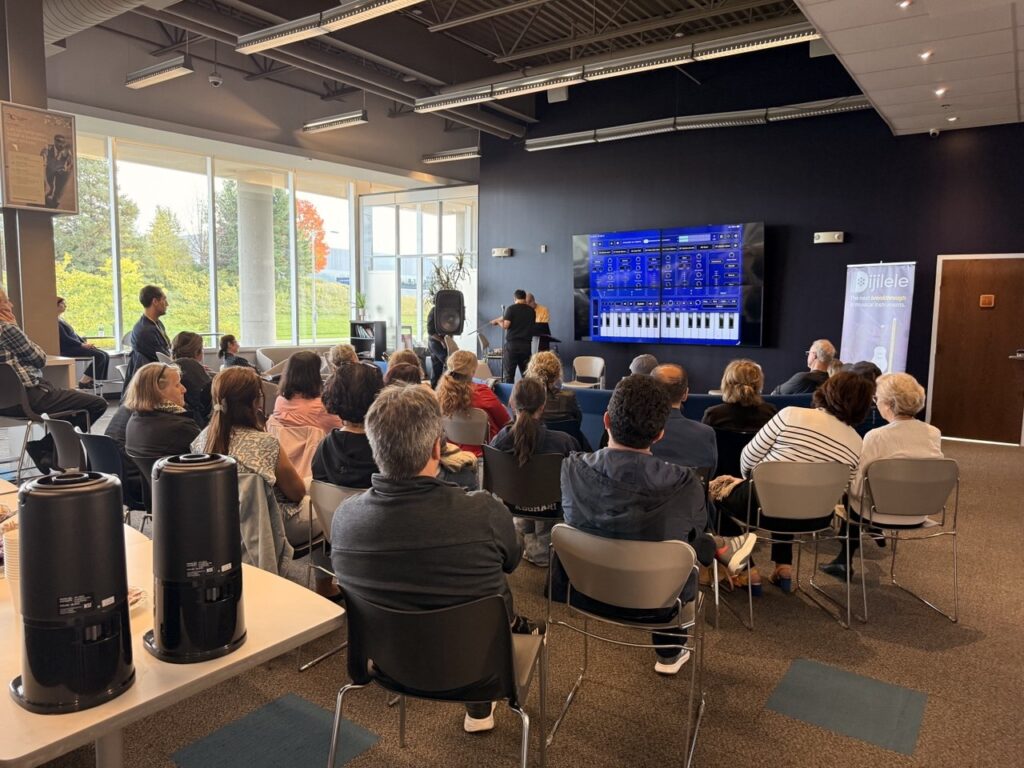
On October 2, 2026, the Dijilele team joined the community at the Accelerator Centre in Waterloo for an evening of music technology, live demonstrations, and conversation.
The workshop, Meet Dijilele: A Live Music Technology Experience, introduced attendees to Dijilele, its development journey, and some of the ways a digital musical instrument can support playing, creating, practising, and exploring music.
From changing tunings to working with digital audio workstations (DAWs), the event gave attendees a closer look at how Dijilele can be used across different musical styles and creative workflows.
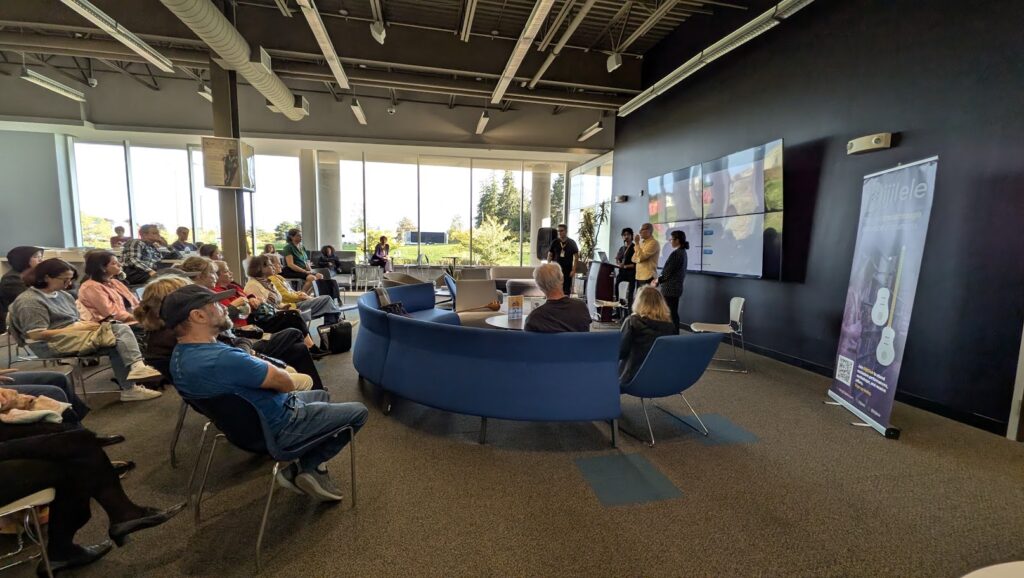
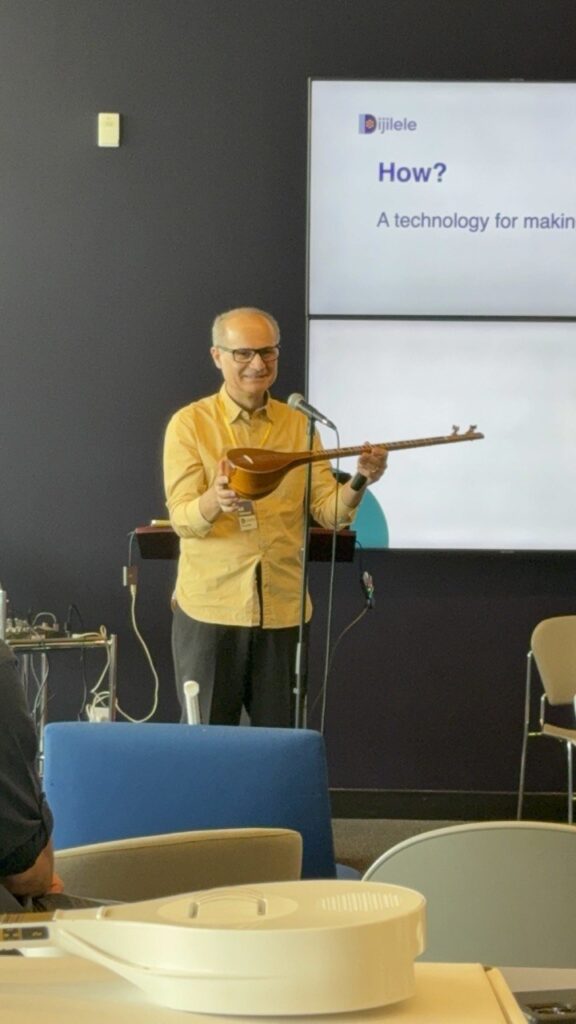
Introducing Dijilele: Its History, Design, and Features
The session began with Dijilele founders Ali Tehrani and Narmé Hejri, who introduced the instrument and shared the story behind its development.
They discussed the history of Dijilele, the ideas that shaped its design, and features that distinguish it from conventional acoustic fretted instruments.
The introduction also provided context for Dijilele as a digital instrument: one designed not only for playing music, but also for accessing different sounds, tunings, digital tools, and approaches to musical creation.

Demonstrating Dijilele Through Live Music
Next, Dijilele Artists Jonathan Markov and Mehrdad Jafari Raad demonstrated some of these features in action.
Rather than discussing the technology only in theory, they showed how Dijilele can fit into different musical situations and creative workflows.
During the demonstration, attendees saw how Dijilele can:
- connect with and work alongside digital audio workstations (DAWs)
- quickly switch between different tunings
- support both Eastern and Western musical traditions
- be used to demonstrate both melodic and harmonic ideas
- provide access to different digital sounds for playing and music creation
The performances also highlighted how the same digital instrument can move between different musical contexts without requiring the physical adjustments normally associated with changing the tuning or setup of an acoustic instrument.


Questions From the Audience
The evening ended with a Q&A session with the Dijilele team. Attendees asked questions ranging from battery life and outdoor performance to education, sound customization, and how skills learned on Dijilele transfer to other instruments.
Here are some of the questions discussed during the workshop.
How long does the Dijilele battery last?
Both Dijilele models are designed to provide up to approximately 10 hours of battery life, depending on how the instrument is being used.
This allows musicians to use the instrument for extended practice, teaching, creative sessions, rehearsals, and performances without needing to remain connected to a power source.
Can you play Dijilele while it is charging?
Yes. Dijilele can be played while charging.
This means that if the battery becomes low during a longer practice, teaching, recording, or creative session, musicians can continue playing while the instrument is connected to power.
Are there education programs for learning Dijilele?
Music education is one of the areas we are continuing to explore as Dijilele develops.
Our workshops and demonstrations already provide opportunities for musicians, learners, and educators to become familiar with the instrument. We are also interested in exploring how Dijilele can support different forms of music teaching and learning as our educational resources continue to grow. Some of our free educational material can now be found on YouTube and more content will be added to our playlists soon.
Are skills learned on Dijilele transferable to and from acoustic instruments?
This was an important question because Dijilele has a different physical design from a traditional acoustic fretted instrument.
Many musical concepts and skills developed through Dijilele can still transfer to other musical contexts. These include understanding melody, rhythm, harmony, scales, chord relationships, timing, coordination, and musical expression.
For musicians who already play instruments such as guitar or ukulele, familiar relationships between notes and frets can also make Dijilele approachable.
At the same time, Dijilele is its own instrument. Its digital design introduces possibilities that are not always available on an acoustic instrument, including quick tuning changes, access to different sounds, and integration with digital music tools.
The goal is therefore not necessarily to reproduce an acoustic instrument exactly, but to provide another way to develop and apply musical skills.
Can you change Dijilele’s sounds if you do not like the default sounds?
Yes. Dijilele’s sounds can be customized.
Musicians are not limited to the sounds that initially come with the instrument. Dijilele can work with SoundFonts, giving users access to a much broader range of instrument sounds.
Thousands of free SoundFonts are available online, representing instruments and sounds from many different musical traditions.
Musicians can also create their own SoundFonts, opening possibilities for highly personalized instruments and sound experiments. For example, sounds created from a person’s own voice can be turned into playable digital sounds.
This makes Dijilele not only an instrument for performing existing music, but also a tool for exploring sound design and digital music creation.
Can Dijilele be played outdoors?
Yes. Dijilele can be played outdoors when weather conditions are appropriate.
As with other electronic instruments, Dijilele should be protected from rain, snow, and conditions that could expose the electronics to moisture.
In suitable weather, however, its built-in sound makes it useful for relatively informal outdoor musical settings.
The volume is particularly well suited to situations where the goal is to accompany people rather than overpower them. Examples could include:
- outdoor sing-alongs
- summer camps
- gatherings in parks
- music around a campfire
- small social performances
- group singing activities
Dijilele’s easy transposition features can also be useful in these situations. A song can be moved to a different key more easily to accommodate different singers and vocal ranges, without requiring the musician to relearn the song in an entirely different fingering pattern.
Exploring New Ways to Play and Create Music
One of our favourite parts of events like this is hearing the questions people ask once they see Dijilele in action.
Questions about transferable musical skills, customizable sounds, outdoor performance, tunings, and education point to a larger conversation about what a digital musical instrument can be.
Dijilele brings together elements of traditional fretted playing and digital music technology. That creates opportunities to explore familiar musical ideas while also experimenting with sounds, tunings, software, and approaches that would be more difficult to access through a conventional acoustic instrument alone.
Thank you to the Accelerator Centre in Waterloo for hosting us, to everyone who joined the workshop, and to our Dijilele Artists Jonathan Markov and Mehrdad Jafari Raad for bringing the instrument’s capabilities to life through music.
We look forward to continuing these conversations at future Dijilele events.
Want to see Dijilele in action? Follow our upcoming events, demonstrations, performances, and educational content to discover more ways to play, create, and explore music with Dijilele.